Dental Implants Explained Simply: The Complete Beginner's Guide for Kota Kinabalu
Confused about dental implants? This simple guide explains implants using everyday analogies, what they are, how they work, and who needs them.
By Borneo Dental Centre, Kota Kinabalu
Every week at our clinic in Kota Kinabalu, someone sits in our chair and asks the same question:
"Doctor, what exactly is a dental implant? Is it like a denture?"
It’s a great question, and the honest answer is that most explanations online are written for dentists, not for normal people. So this article explains implants the way we explain them over teh tarik: with simple pictures you already understand.
Your tooth is like a tree
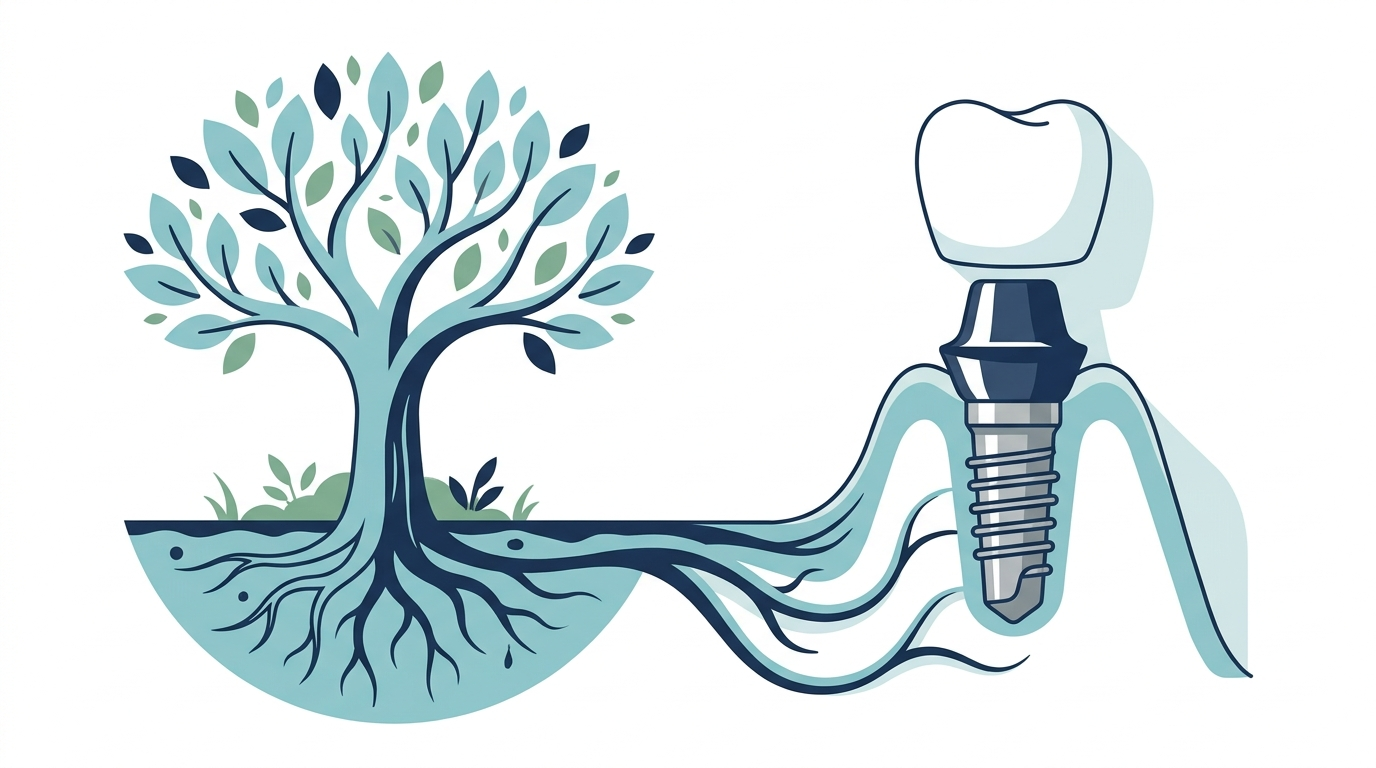
Think of a healthy tooth as a tree. The crown, the white part you see, is the trunk and leaves. But what actually holds the tree up through every storm? The roots, buried deep in the ground.
Your tooth is the same. The root sits inside your jawbone, anchoring it firmly so you can bite into buah tarap, chew sotong, and crack groundnuts without a second thought.
When you lose a tooth, you don’t just lose the white part. You lose the root, the anchor. And that’s where the real trouble begins.
What happens when the tree is gone? The soil washes away
Here’s the part most people have never been told.
When a tree is removed, the soil around it slowly erodes. Nothing is holding it in place anymore, so rain washes it away, year after year.
Your jawbone behaves exactly the same way. Bone stays strong only when it’s being used, when a root presses into it every time you chew. Remove the root, and your body quietly says: "No tooth here anymore? Then I don’t need this bone." It begins to shrink.
This is why people who lost teeth years ago often notice their face looking "sunken" or older around the mouth. It’s not age. It’s the missing foundation.
And this is also why waiting is the most expensive decision in dentistry: the longer the gap sits empty, the less bone remains to work with later.
So what is a dental implant? A new root, not just a new tooth
A dental implant is, quite simply, a replacement root.
It’s a small post made of medical-grade titanium, the same material used in hip replacements and aircraft, placed into the jawbone where your natural root used to be.
Here’s the analogy we use every day:
A denture is like renting a house. A bridge is like leaning on your neighbours. An implant is like building on your own foundation, it’s yours, it’s solid, and it’s built to last decades.
Let’s unpack that:
A denture is renting. It sits on top of your gums, comes out at night, can slip when you laugh or eat, and does nothing to stop the bone underneath from shrinking. Convenient, cheaper upfront, but you never really own the result.
A bridge is leaning on your neighbours. To fill one gap, the dentist must shave down the two healthy teeth beside it to hold the bridge. You’ve solved one problem by putting a burden on two innocent teeth.
An implant is building your own foundation. It stands independently, doesn’t touch your other teeth, stimulates the bone just like a natural root (so the "soil" stops washing away), and with proper care can last 20–30 years or more.
How does metal become part of your body?
This is the part that sounds like science fiction but is beautifully simple.
Titanium has a rare property: your bone doesn’t reject it, it grows onto it. Over about 2–4 months, bone cells attach themselves directly to the implant surface, locking it in place. Dentists call this osseointegration.
Think of it like planting a fence post in wet cement. On day one, the post is placed carefully and left undisturbed. Weeks later, the cement has hardened around it completely, and now that post isn’t going anywhere.
Once the bone has locked the implant in, we attach a custom-made crown on top, matched to the colour and shape of your natural teeth. Most people, even your family, won’t be able to tell which tooth is the implant.
The three parts of an implant (one more analogy)
An implant tooth has three parts. Think of a lamp post:
- The implant, the foundation buried in the ground (your new titanium root)
- The abutment, the pole connector
- The crown, the light on top (the beautiful tooth everyone sees)
Each part is made and fitted precisely for you. At Borneo Dental Centre we plan this digitally first, using 3D scans of your jaw, so we know the exact position, angle, and depth before treatment ever begins. No guesswork.
"Is it painful?" The question everyone is afraid to ask
Here’s what surprises almost every patient: most people say getting an implant was easier than having the tooth taken out in the first place.
The procedure is done under local anaesthetic, the same numbing you’d have for a filling. Most patients are back at work the next day, managing any mild soreness with regular painkillers.
"I was so nervous I waited 3 years. The implant itself? Easier than the extraction. I wish I hadn’t waited." That’s the sentence we hear most often at our clinic.
Who is an implant for?
You may be a candidate for an implant if:
- You’ve lost one tooth, several teeth, or all your teeth
- You’re tired of a loose or uncomfortable denture
- You want to avoid shaving down healthy teeth for a bridge
- Your remaining bone is still adequate, and even if it isn’t, bone grafting can often rebuild it
Age is rarely the barrier people think it is. We regularly place implants for patients in their 60s and 70s. What matters is your health and your bone, both of which we assess properly before recommending anything.
The honest conclusion
A missing tooth is never just a gap. It’s a foundation problem that quietly gets worse every year, and the earlier it’s addressed, the simpler and more affordable the solution.
The best time to replace a missing tooth was the day you lost it. The second best time is now, before the bone underneath makes the decision for you.
If you’ve been living with a missing tooth or a denture you don’t love, the first step is simple: find out where you stand.
Book an Implant Assessment at Borneo Dental Centre, Kota Kinabalu. Your assessment includes a 3D CBCT scan of your jaw, a digital simulation of your result, and a clear written treatment plan with options, so you can make this decision with complete information, no pressure.