Missing a Tooth? What Happens in the First 12 Months (Kota Kinabalu Dentist)
A missing tooth left untreated starts changing your jawbone within weeks. A Kota Kinabalu dentist explains the 12-month countdown, and when to act, in Sabah.
By Dr Ghanarupan, Borneo Dental Centre, Kota Kinabalu, Sabah
There’s a sentence I hear in our Kota Kinabalu clinic more than any other:
“It’s just one tooth at the back, Doc. Nobody sees it.”
I understand it completely. No pain, no visible gap, life is busy. So the plan becomes later. Next year. When things slow down.
Here’s what nobody tells you: your jawbone didn’t get the memo. From the day a tooth comes out, the bone that held it starts a countdown of its own, quietly, painlessly, and on a schedule that doesn’t wait for yours.
This article walks you through that first year, so patients across Kota Kinabalu, Penampang, and the wider Sabah region know exactly what a missing tooth is doing beneath the surface. Not to frighten you, but to give you the one thing “later” takes away: an informed choice about timing.
Why bone disappears when a tooth does
A tooth is like a building on piling: the root anchored deep in bone. But that piling does a second job no one mentions: it keeps the ground alive.
Bone behaves like muscle. Every time you chew, the root transmits tiny forces into the jaw, and the bone responds by staying dense and tall. Remove the root, and the body reads the silence as a signal: this bone is no longer needed. So it begins reclaiming it, the same way an unused muscle shrinks.
Dentists call it resorption. We call it what it is: your jaw slowly deleting the foundation while you’re deciding what to build on it.
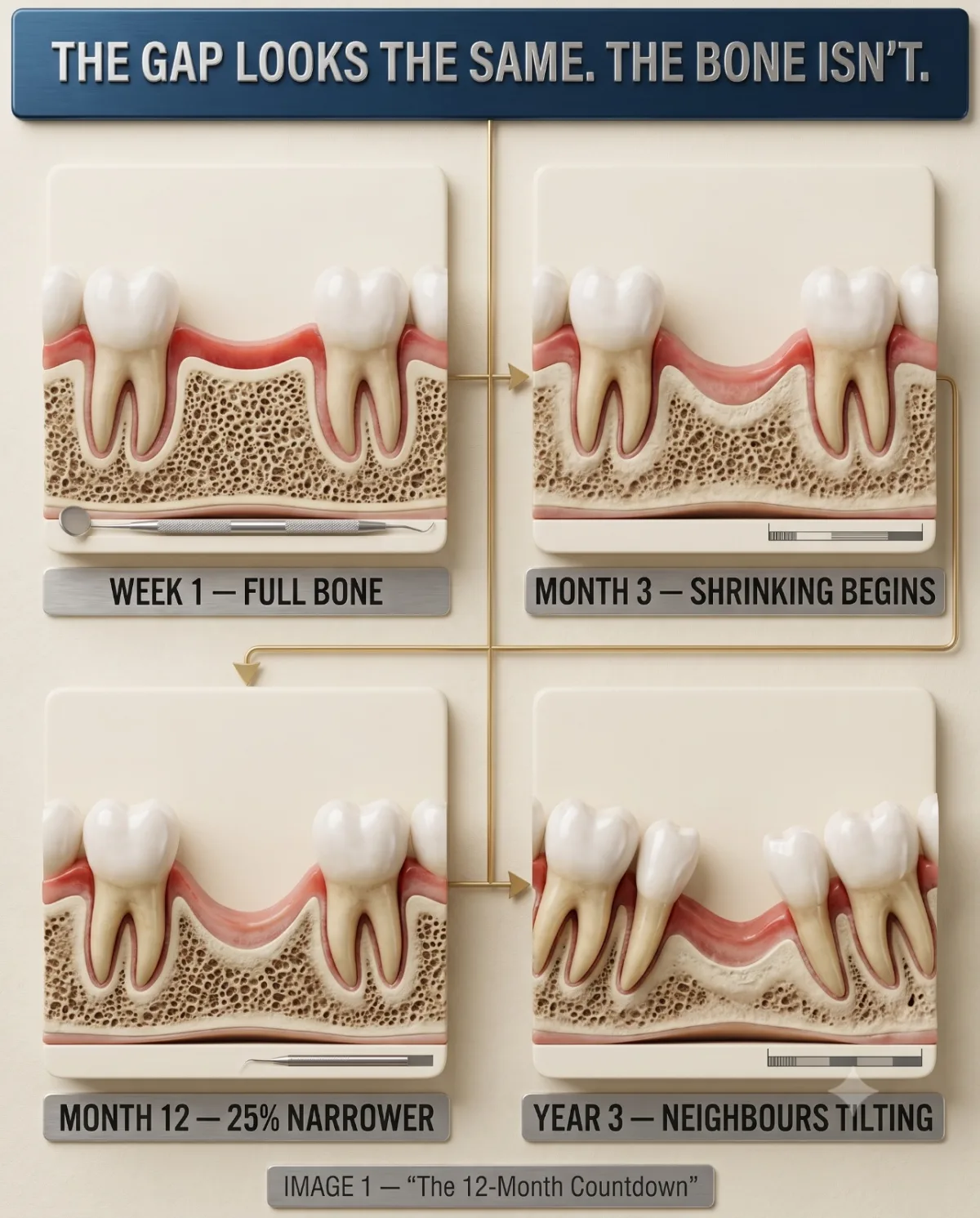
The first year, month by month
Weeks 1 to 8, the quiet start. The gum heals over and everything looks finished. Underneath, the bone walls of the empty socket are already narrowing. This surface healing is exactly what makes “later” feel safe.
Months 3 to 6, the fastest losses. This is the steepest part of the curve; most of the first year’s bone shrinkage happens in this window. The ridge loses width first, becoming narrower and sharper under the gum.
Month 12, the quarter mark. By around the one-year point, the bone can lose up to a quarter of its width. Still invisible from the outside. Still painless. Still shrinking.
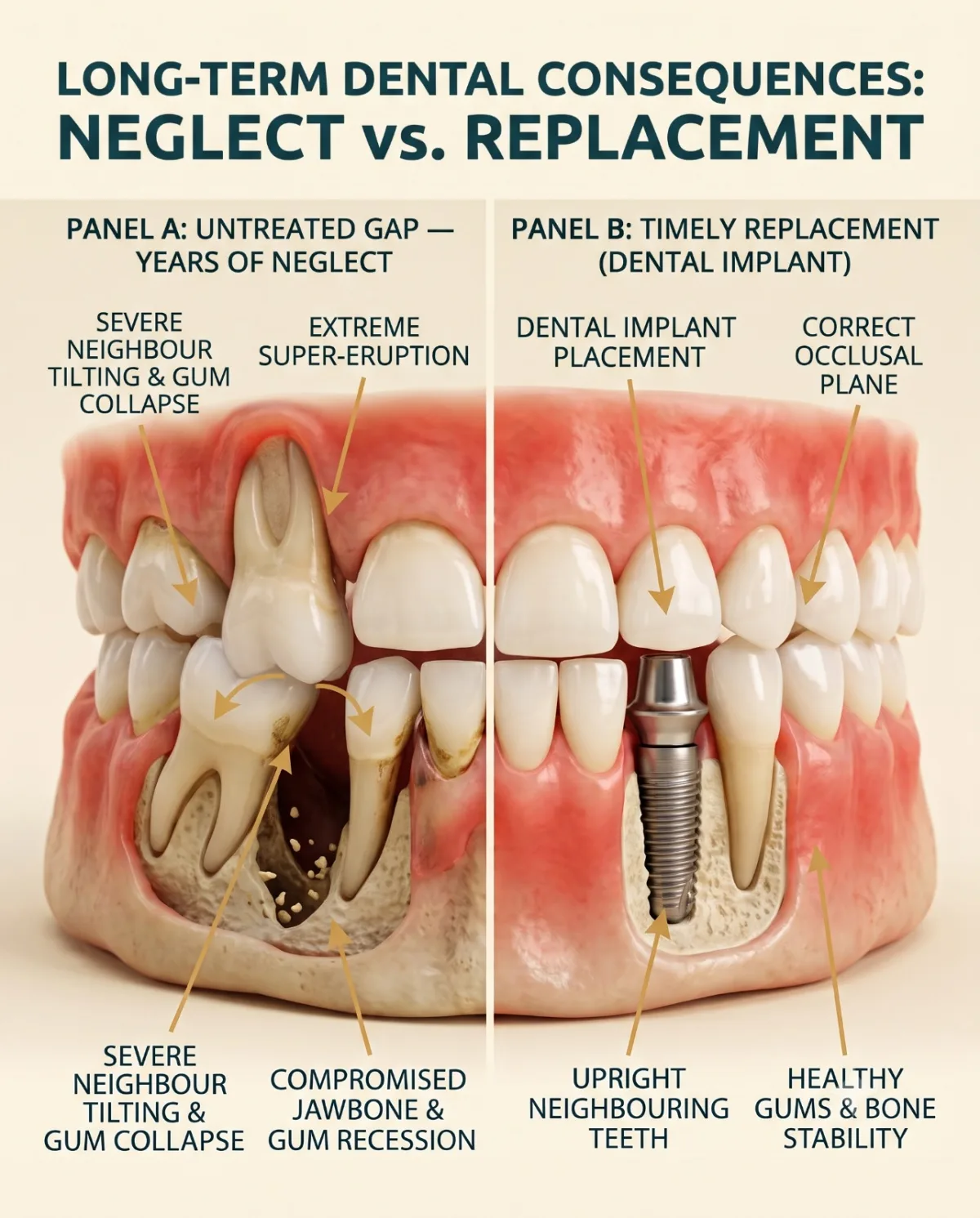
Years 2 to 3, the neighbours move in. Teeth are team players; remove one and the team breaks formation. The teeth beside the gap begin tilting into it. The opposing tooth above (or below) starts drifting down into the space, because nothing pushes back anymore. New food traps form around the tilted teeth, and those become tomorrow’s decay and gum problems. One gap has quietly become a three-tooth issue.
The part that matters most: the door doesn’t close, it narrows
Let’s be precise here, because scare tactics annoy us as much as they annoy you.
Losing bone does not mean losing the option of a dental implant. What it changes is the route. An implant needs enough bone to anchor in; piling needs ground. Treat the gap while the bone is still full, and the treatment is usually at its simplest: one implant, one procedure, done.
Wait years, and the same result often needs an extra chapter first: bone grafting, rebuilding ground before the piling can go in. Very doable, very routine for a specialist. But it’s more healing time, more visits, more complexity, all for the same tooth you could have replaced more simply earlier.
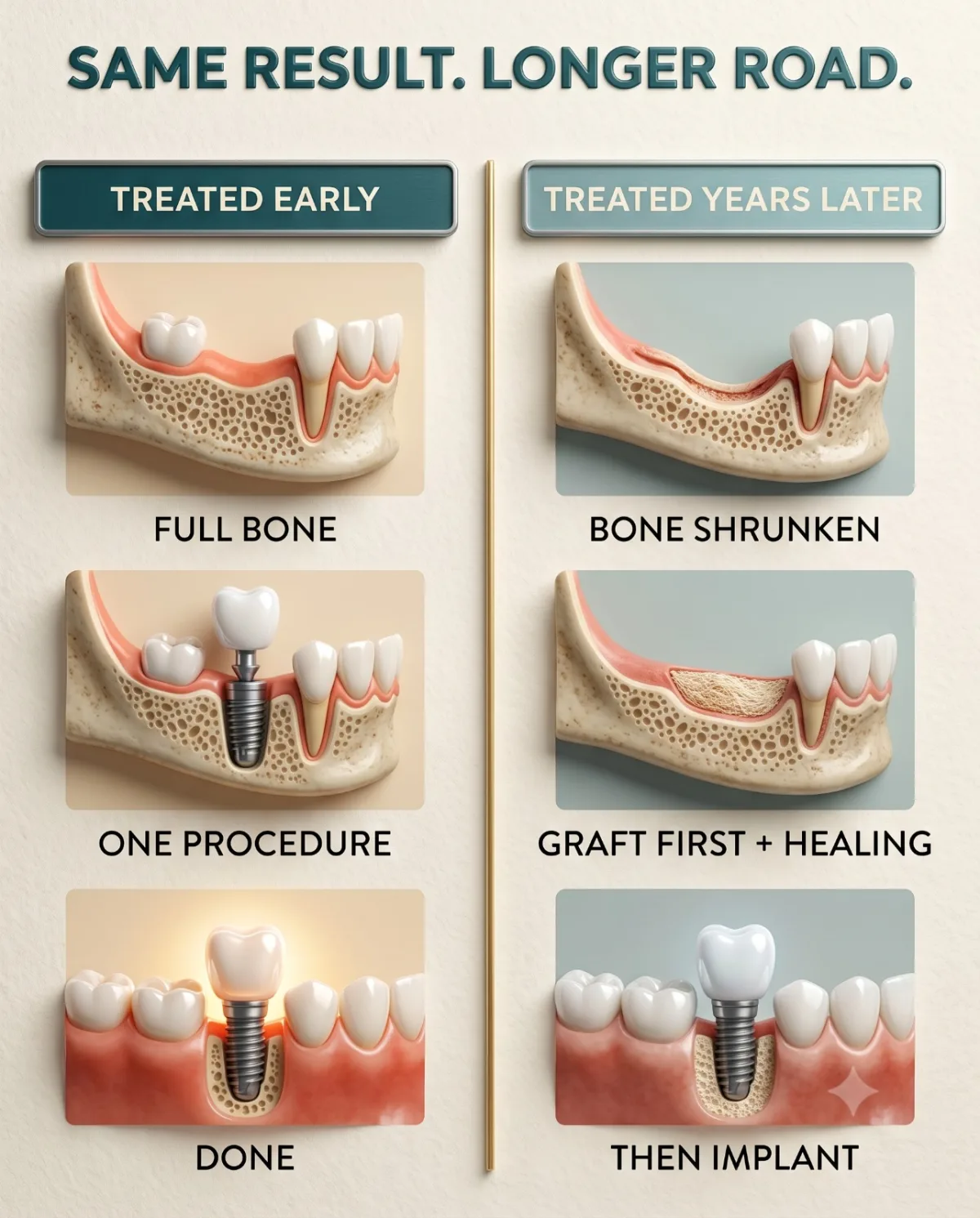
The honest summary: time doesn’t disqualify you. It just makes the road longer.
“My tooth’s been gone for years, should I even bother asking?”
Yes, and this might be the most important paragraph in the article.
At our clinics in Kota Kinabalu and Penampang, we regularly assess patients whose gaps are five, ten, even twenty years old, and many still have enough bone for a straightforward implant. Bone loss varies enormously from person to person; the only way to know your situation is to actually look at your bone in 3D. Never assume you’ve missed the window based on a guess, or on this article.
Rapid-fire answers
Does the bone loss hurt? No, that’s the trap. Resorption is completely painless. The first “symptom” most people notice is years later, when neighbouring teeth have shifted or a denture stops fitting.
Can anything stop the bone loss except an implant? Honestly, no. Dentures and bridges replace the visible tooth, but neither puts a root back in the bone, so the shrinking continues underneath them. An implant is the only replacement that gives bone the stimulation it needs to stay.
I just had a tooth extraction, how long do I have? The simplest window is generally within the first few months, before the steep part of the curve. In some cases our specialist can even plan the implant path at the time of extraction. If your extraction is recent, this is the ideal moment to get assessed in Kota Kinabalu.
What does an assessment involve? A 3D CBCT scan (we look at your bone’s width and height precisely), a digital preview, and a written plan in plain language. No commitment, no pressure; the point is to know exactly where you stand.
Find out where your countdown stands: Kota Kinabalu & Penampang
Every jaw resorbs at its own pace. Yours may be further along than you think, or in far better shape than you fear. There’s exactly one way to know.
Book an Implant Assessment at Borneo Dental Centre, with branches in Luyang, Kota Kinabalu and Pavilion Bundusan, Penampang, Sabah: 3D CBCT scan, digital preview, written plan. If you proceed, your implant is placed by a dental specialist, not a general practitioner. Eligible patients can split treatment over six months, interest-free; ask us when you visit.
Borneo Dental Centre: world-class dentistry in Kota Kinabalu, Sabah. 📞 +6019-411 1213 · 💬 WhatsApp us · 🌐 Book your Implant Assessment
Next in the series: why do some implants last 3 years and others last 30? The five differences nobody advertises.
Dr Ghanarupan practises at Borneo Dental Centre, Kota Kinabalu, where all dental implants are placed by the centre’s dental specialist.