Why Do Dental Implants Fail? 5 Differences That Decide (Kota Kinabalu Dentist)
Some implants last 3 years, others last 30. A Kota Kinabalu dentist explains the 5 differences that decide, and the questions to ask any clinic in Sabah first.
By Dr Ghanarupan, Borneo Dental Centre, Kota Kinabalu, Sabah
Two people get a dental implant in the same month, in the same city.
Thirty years later, one of them is still chewing on theirs. It has outlived two cars and a mortgage. The other lost theirs by year three: loose, infected, removed.
Same word on both receipts: “implant.” Same titanium. Often the same city.
So what was actually different?
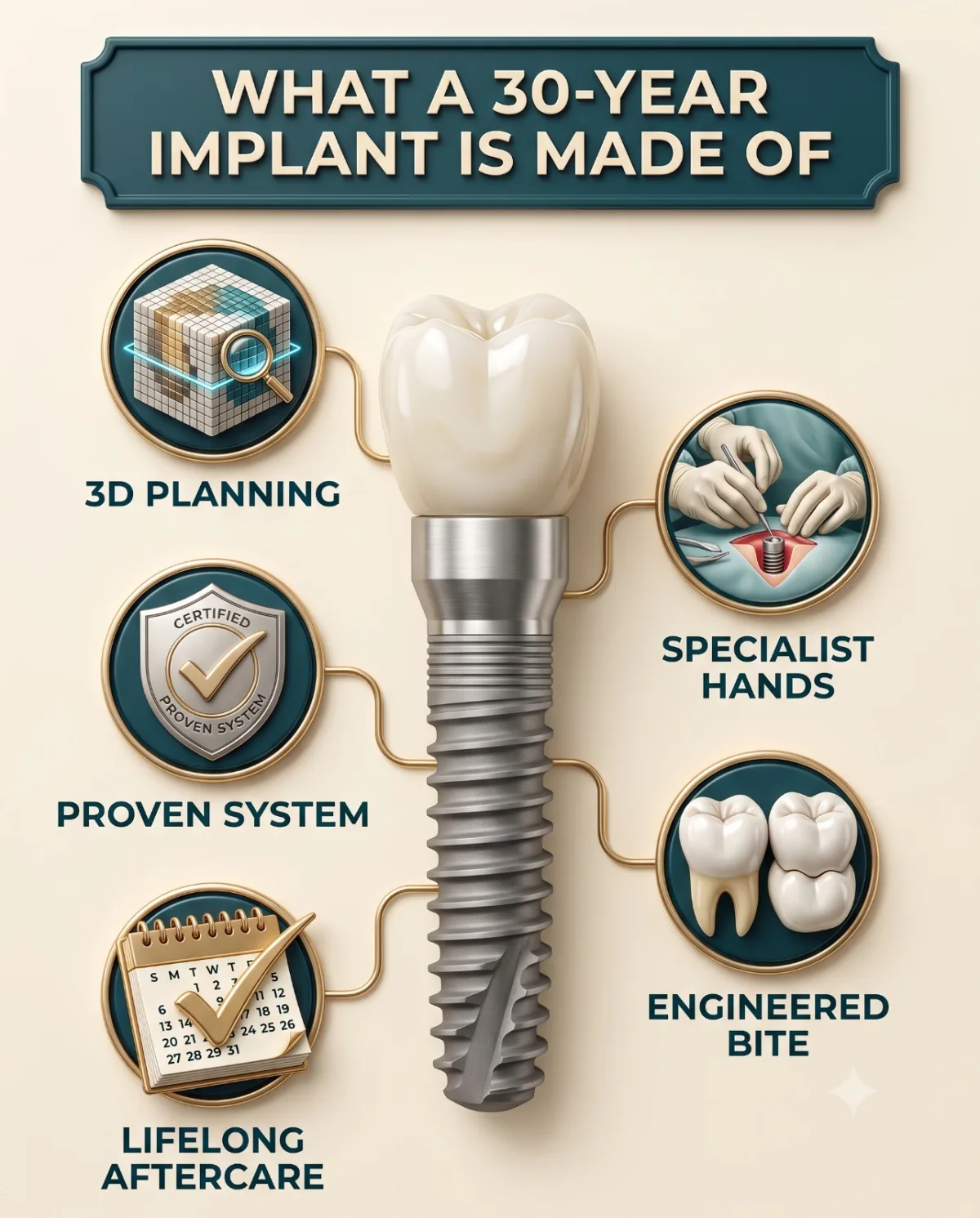
In Article 1 we covered what an implant is; in Article 2, why timing matters. This one answers the question that should matter most to anyone comparing dental implant clinics in Kota Kinabalu, and I promise you it is not the question most people ask. Almost nothing in implant dentistry fails because of the implant. It fails because of decisions made around the implant. Five of them.
Difference 1: Whether the ground was checked before the piling went in
Think of Imago Mall right here in Kota Kinabalu. The whole mall stands on reclaimed land, ground that used to be sea. Before anything went up, engineers spent months checking what was underneath: how soft the ground is, how deep the solid layer sits. Only then did the piling go in. That’s the only reason a building that size can sit safely on soft coastal ground.
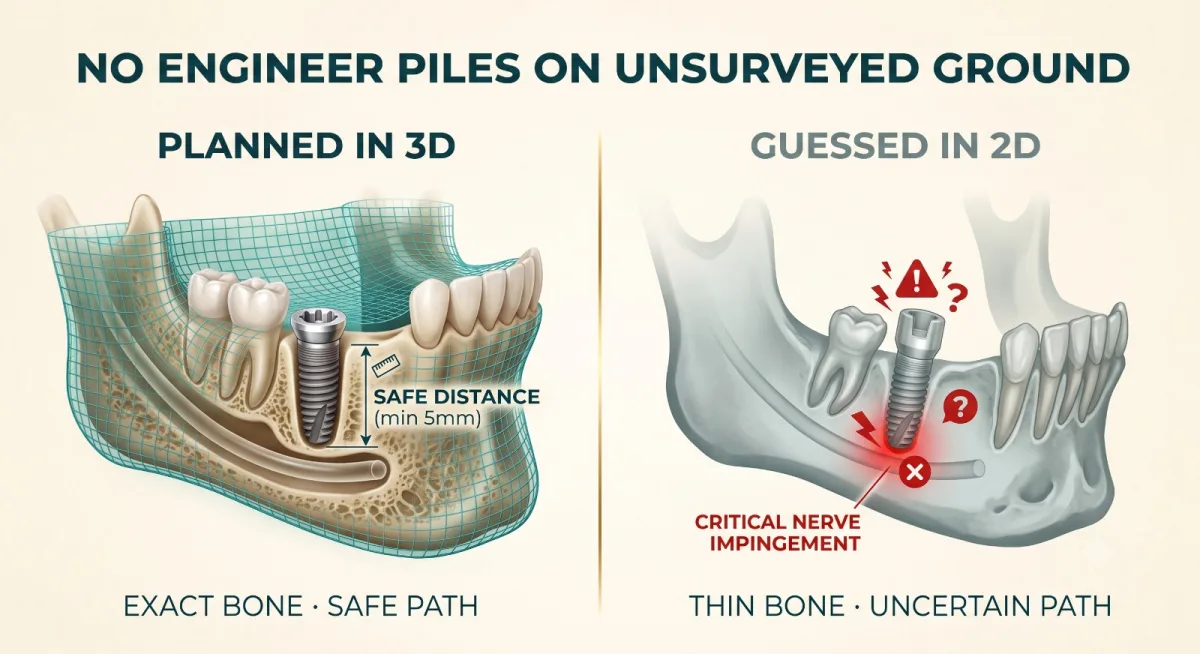
Your jawbone deserves the same ground check. Ours is the 3D CBCT scan: it shows exactly how wide, how tall and how solid your bone is, and exactly where the nerve and sinus sit. Planned this way, the implant goes precisely where the bone is strongest, with everything important safely out of the way.
The old way still exists: placing implants from a flat 2D X-ray. That’s like judging the ground from a photo. Sometimes it works out. Sometimes the implant sits in thin bone from day one, and its countdown starts before the crown is even fitted.
A 30-year implant is planned in 3D. A 3-year implant is often guessed from a flat picture.
Difference 2: Whose hands placed it
Implant placement is surgery in a small space crowded with nerves, sinuses and blood supply, where millimetres matter. A dental specialist has spent years of additional formal training in exactly this anatomy and exactly these complications: not just how to place an implant, but what to do when a case refuses to be a textbook case.
Here’s what few patients in Kota Kinabalu and Penampang know: in many places, a general dentist can legally place implants after a short course. Legal is not the same as equal. Ask any engineer whether they’d let the architect also do the piling.
At Borneo Dental Centre, every implant is placed by our dental specialist. Not sometimes. Every one.
Difference 3: Which implant system went into your jaw
This one is almost invisible to patients, and it might matter most of all in year fifteen.
Established implant systems have decades of published research, refined surfaces engineered for bone bonding, and, critically, a global supply of spare parts. An implant is a system: crowns wear, screws need servicing, components occasionally need replacement over a 30-year life.
At Borneo Dental Centre, we primarily use Straumann, the Swiss system that is, by most measures, the most scientifically documented implant in the world. Straumann has been researching and manufacturing implants since the 1970s, has placed millions of implants across the globe, and its long-term clinical studies consistently report survival rates in the mid-to-high 90s percent at the 10-year mark. Its surface technology (the part your bone actually bonds to) is the product of five decades of Swiss engineering, and, the part that matters in year fifteen, its components are supported by a worldwide network, so a Straumann implant placed in Kota Kinabalu today can be serviced almost anywhere on earth, decades from now.
There are also dozens of budget systems with thin track records. The implant may go in fine. But in year twelve, when a component needs replacing, the question becomes: does this system still exist? Do parts for it still exist, in Malaysia, in Sabah? An implant with no available parts is a car nobody makes spares for. Ask what brand is going into your jaw, and whether it will still be supported when your grandchildren are born. A clinic proud of its system will answer instantly: you’ve just read our answer.
Difference 4: How the bite was engineered
An implant is anchored rigidly in bone. That’s its superpower, and its one vulnerability. A natural tooth has a ligament that cushions it; an implant takes every chewing force raw.
If the crown is built even slightly too high or angled wrong, one implant silently absorbs punishment meant for a whole team of teeth, thousands of bites a day. Bone strain, screw loosening, fractures follow. This is invisible craftsmanship: the difference between a crown that fits and a bite that was engineered. You can’t see it in the mirror. You feel it in year ten.
Difference 5: What happened after everyone went home
Implants can’t get cavities, so many people conclude they need no care. This mistake has a name: peri-implantitis, gum and bone infection around an implant, and it is the leading cause of late implant loss.
The 30-year implant belongs to someone who cleans around it like a natural tooth and shows up for reviews, where early trouble is caught while it’s still reversible. The 3-year implant often belongs to someone who was never told this, because the conversation ends at payment in some places. Aftercare isn’t the fine print of implant treatment. It’s half the treatment.
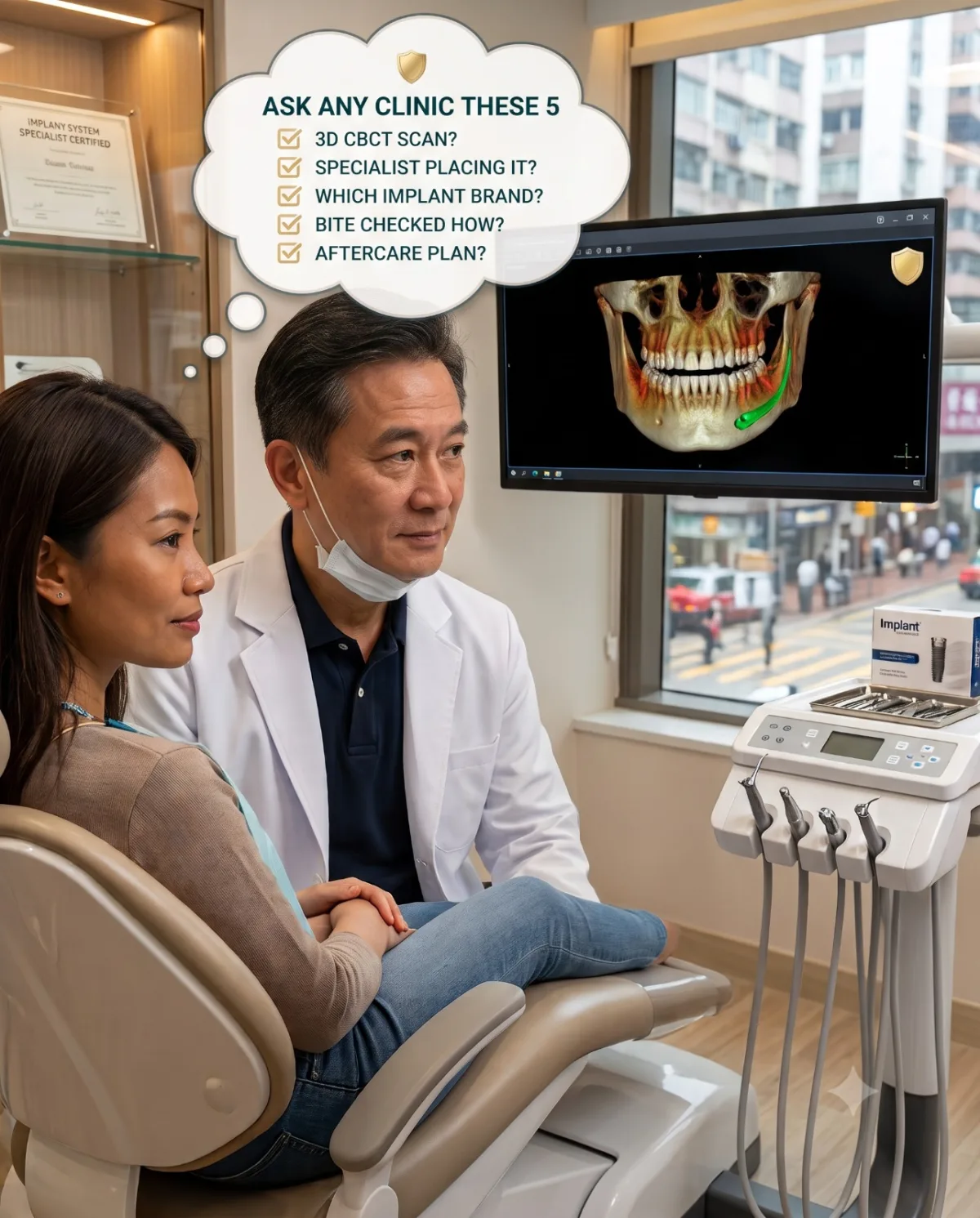
The five questions that protect you, at any clinic in Sabah
Not just ours. Print this, screenshot it, take it anywhere in Kota Kinabalu, Penampang, or beyond:
- “Will my implant be planned on a 3D CBCT scan?”
- “Who exactly places the implant, and are they a specialist?”
- “Which implant system do you use, and will its parts be available in 20 years?”
- “How do you check and adjust my bite on the final crown?”
- “What does the aftercare and review programme look like?”
A clinic that answers all five clearly and happily is a clinic taking your next 30 years seriously. A clinic that gets vague on any of them has answered you too.
Rapid-fire answers
What’s the actual failure rate? Properly planned, specialist-placed implants succeed at rates in the high 90s percent over the long term, among the most reliable procedures in dentistry. Most failures trace back to one of the five differences above, not to bad luck.
What are the warning signs of a failing implant? Looseness, bleeding or swelling of the gum around it, pain on biting, or a bad taste around the implant. Any of these = see your dentist promptly; caught early, many problems are fixable.
Can a failed implant be replaced? Often yes, after the site heals, sometimes with grafting first (see Article 2 on bone). Better to build it right the first time.
Do implants need special cleaning? Nothing exotic: proper brushing, cleaning between teeth, and regular professional reviews. The routine is simple, it just isn’t optional.
Built for year thirty, not year one: Kota Kinabalu & Penampang
Our Implant Assessment exists so that every one of the five differences is settled before anything touches your jaw: a 3D CBCT scan, a specialist-planned placement, a Straumann implant system, an engineered bite, and a review programme that continues long after the crown is fitted, all explained in a written plan you keep. Available at our Luyang, Kota Kinabalu and Pavilion Bundusan, Penampang, Sabah branches. Eligible patients can split treatment over six months, interest-free; ask us when you visit.
Borneo Dental Centre: world-class dentistry in Kota Kinabalu, Sabah. 📞 +6019-411 1213 · 💬 WhatsApp us · 🌐 Book your Implant Assessment
Next in the series: the foods you quietly stopped ordering, what tooth loss really takes from a life in Sabah, and how people get it back.
Dr Ghanarupan practises at Borneo Dental Centre, Kota Kinabalu, where all dental implants are placed by the centre’s dental specialist.